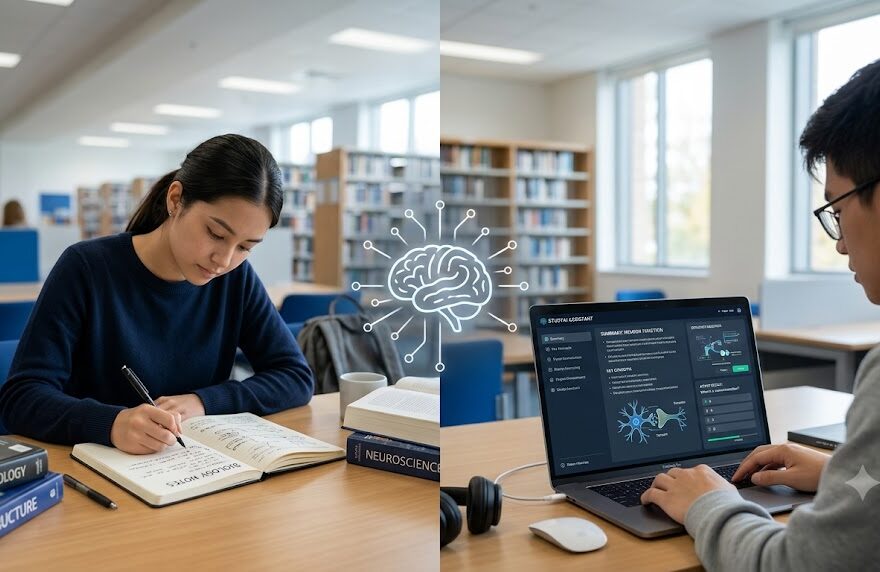
In today’s digital learning environment, students have more ways to study than ever before. Artificial intelligence (AI) tools can summarise textbooks, explain difficult concepts, generate practice questions, and organise study materials within seconds. At the same time, handwritten notes remain a popular learning method because they encourage students to process information while writing.
But which approach helps students remember more: AI-generated summaries or traditional handwritten notes? The answer depends on how students use these methods. Research on learning suggests that active recall, meaningful processing, and spaced practice are more important for long-term retention than simply choosing between paper and digital tools.


How Handwritten Notes Support Memory and Understanding
Handwritten notes can help students learn because writing requires them to select, organise, and express information in their own words. Instead of copying every sentence from a textbook, students often need to decide which ideas are important and how those ideas connect.
This process encourages deeper thinking. For example, a student studying biology might write a short explanation of photosynthesis rather than copying an entire textbook paragraph. By simplifying the concept, the student has an opportunity to process its meaning.
Handwriting can also help students create diagrams, flowcharts, mathematical equations, and mind maps. These visual representations are particularly useful for subjects that involve relationships between concepts, including mathematics, science, geography, and computer science.
However, handwriting is not automatically superior to digital learning. Students who copy notes mechanically without understanding them may remember very little. Handwritten notes become more valuable when students actively summarise, compare, question, and explain the information they are recording.
How AI Study Tools Can Improve Learning
AI-powered learning tools can make studying more efficient by helping students break down complicated subjects into manageable explanations. A student struggling with calculus, for example, can ask an AI assistant to explain a theorem step by step, provide a simpler example, or identify a mistake in their reasoning.
AI can also generate summaries, quizzes, flashcards, practice questions, and revision schedules. These features allow students to spend less time organising information and more time practising what they have learned.
Another advantage is personalised learning. Students can request explanations suited to their current knowledge level, ask follow-up questions, and explore alternative methods of solving a problem. This flexibility can be particularly useful when a teacher or tutor is not immediately available.
Nevertheless, AI has limitations. A summary may omit important details, an explanation may contain factual errors, and an answer that looks convincing may still be incorrect. Students who depend entirely on AI-generated notes can also develop a false sense of understanding because recognising a clear explanation is easier than reproducing the same explanation independently.
The best use of AI is to support thinking, not replace it. Students should verify important information against textbooks, class materials, and reliable educational sources.
Active Recall: The Learning Technique That Connects Both Methods

Active recall is a learning technique in which students try to retrieve information from memory without looking at the answer. Instead of repeatedly reading a chapter, they close the book and attempt to explain the main ideas themselves.
For example, after studying a mathematics formula, a student can cover the solution and solve a similar problem independently. After learning a history chapter, the student can write down important events, dates, and causes from memory.
This approach is valuable because it reveals what students actually know and which topics need further revision. Research on retrieval practice has repeatedly shown that attempting to recall information can improve long-term retention compared with relying on repeated study alone.
Handwritten notes and AI can both support active recall. Students can use their notebooks to write answers from memory or ask AI to generate questions without showing the solutions immediately.
Spaced repetition strengthens this process further. Rather than reviewing everything in one long session, students revisit material at increasing intervals—for example, after one day, three days, seven days, and fourteen days. The exact schedule can be adjusted according to the difficulty of the topic and how well the student remembers it.
AI vs Handwritten Notes: A Practical Comparison
| Learning factor | Handwritten notes | AI-assisted study |
|---|---|---|
| Understanding concepts | Encourages personal processing and explanation | Offers alternative explanations and examples |
| Memory practice | Supports recall when used for self-testing | Can generate quizzes and recall prompts |
| Study speed | Usually slower to create | Can summarise information quickly |
| Mathematical learning | Useful for working through calculations | Helpful for hints and step-by-step explanations |
| Personalisation | Depends on the student’s own organisation | Explanations can be adapted to individual needs |
| Main risk | Copying without understanding | Passive dependence or inaccurate information |
Neither method guarantees better results. The deciding factor is whether students actively engage with the material or simply consume information.
How Students Can Combine AI and Handwritten Notes

A combined study strategy allows students to benefit from the speed of AI while retaining the deeper engagement encouraged by handwritten work.
Start with the learning objective. Before using AI, identify what you need to understand. Instead of asking for a complete chapter summary, ask for an explanation of a specific concept, its key principles, and one example.
Create handwritten notes in your own words. After reading the explanation, close the AI tool and write the main ideas in a notebook. Include important definitions, formulas, diagrams, and examples. This step helps you distinguish between information you understand and information you have merely read.
Test yourself without looking. Once you finish writing, close your notebook and answer questions from memory. You might explain the topic aloud, solve a problem, or write a short summary on a blank sheet of paper.
Use AI to identify knowledge gaps. Compare your answer with the textbook or trusted course material. You can then ask AI to generate additional practice questions about the parts you found difficult. For important or technical subjects, verify the explanations and answers independently.
Review at spaced intervals. Return to the topic the following day and test yourself again. Repeat after several days and then a week or two later. Spend more time on concepts that remain difficult instead of reviewing everything equally.
This process transforms AI from a shortcut for producing notes into a tool for strengthening independent learning.
A Sample 30-Minute Study Session
Students do not need complicated technology or expensive resources to apply these techniques. A simple routine can combine digital assistance, handwriting, and retrieval practice.
5 min
Understand the concept
Use a textbook or AI assistant to clarify the main idea and review a worked example.
10 min
Write your own notes
Record the essential points, equations, and examples without copying entire paragraphs.
10 min
Practise active recall
Close your notes and solve a problem or explain the concept from memory.
5 min
Check and correct
Verify your answers, identify mistakes, and record what you need to revise next.
This routine can be adapted to school subjects, university courses, competitive examinations, and independent online learning. For mathematics, allocate more time to solving problems. For theory-heavy subjects, focus on definitions, comparisons, explanations, and factual recall.
Common Mistakes Students Should Avoid
One common mistake is asking AI to create complete notes and then reading them repeatedly without testing understanding. Well-organised summaries can feel easy to learn, but familiarity does not necessarily mean that information can be retrieved during an examination.
Another mistake is writing too much. Copying an entire textbook chapter into a notebook can consume valuable time without requiring much thought. Effective notes should highlight essential ideas and connections rather than reproduce every sentence.
Students should also avoid using AI to solve every problem immediately. When learning mathematics or science, attempting a problem independently before requesting a hint can develop stronger problem-solving skills. If the first attempt fails, a small hint may be more useful than a complete solution.
Finally, students should not confuse study time with learning outcomes. Spending three hours rereading notes is not necessarily more effective than spending a shorter period retrieving information, correcting mistakes, and reviewing difficult concepts.
Conclusion: Which Learning Method Should Students Choose?
AI and handwritten notes serve different purposes, and students can benefit from using both. Handwriting encourages learners to organise ideas in their own words, while AI can provide quick explanations, practice questions, and personalised support. Neither method is sufficient if students remain passive throughout the learning process.
The most effective approach is to use AI to understand difficult material, handwritten notes to process the essential ideas, active recall to test memory, and spaced repetition to strengthen retention over time.
Ultimately, students remember more reliably when they practise retrieving and applying information—not simply when they produce more notes. By combining traditional study habits with responsible AI use, learners can develop better understanding, stronger recall, and greater independence in their education.