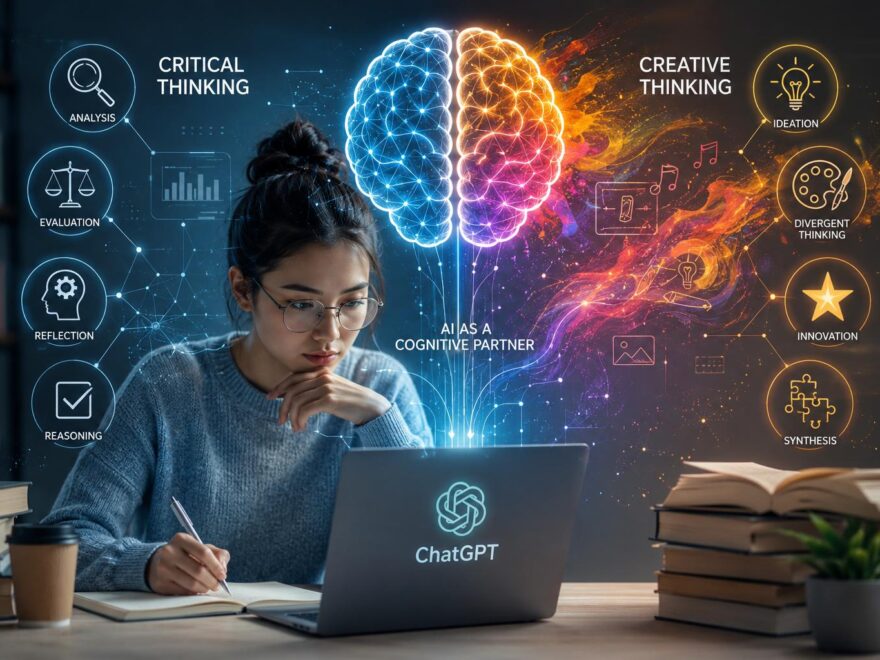
Understanding the Impact of Artificial Intelligence on Independent Reasoning, Problem-Solving, Creativity, and Learning

Introduction
Artificial intelligence is rapidly changing the way students learn, study, and complete academic assignments. AI-powered chatbots such as ChatGPT and other generative AI tools can explain complicated concepts, summarize lengthy textbooks, solve mathematical problems, generate essays, and provide instant answers to almost any academic question.
For students, these technologies offer an attractive learning experience. Instead of spending hours searching through books or websites, learners can ask an AI chatbot a question and receive an explanation within seconds.
However, an important question is emerging in education: Can relying too heavily on AI chatbots weaken students’ critical thinking skills?
Critical thinking involves evaluating information, questioning assumptions, identifying errors, comparing evidence, developing arguments, and reaching independent conclusions. These abilities develop through active intellectual effort rather than simply receiving correct answers.
The concern is not necessarily that AI makes students less intelligent. Instead, excessive dependence on AI-generated answers may reduce opportunities to practise independent reasoning, analytical thinking, creativity, and problem-solving.
Research into AI-assisted education suggests that these technologies can support learning, but their effects depend considerably on how students use them and how educational institutions design learning activities.
What Does Recent Research Say About AI and Critical Thinking?
The scientific evidence is more nuanced than a simple yes-or-no answer. Several studies published in 2026 have examined whether generative AI strengthens students’ reasoning abilities or encourages dependence on automated answers.
Here are some important findings.
A systematic review of 65 empirical studies
A systematic review published in Thinking Skills and Creativity in June 2026 examined 65 high-quality empirical studies involving students and investigated ChatGPT’s relationship with critical thinking.
The researchers found that ChatGPT could support analytical, interpretive, reasoning, and self-regulatory skills when integrated into structured educational activities. However, evidence was less consistent regarding the development of critical thinking dispositions, including curiosity, open-mindedness, truth-seeking, and systematic thinking.
This distinction is important: students may become better at completing certain analytical tasks without necessarily developing a lasting habit of independent critical thinking. ScienceDirect
A review of 89 studies identifies the dependency risk
A 2026 systematic review published in Frontiers in Psychology examined 89 peer-reviewed studies on generative AI and higher-order cognitive skills among university students.
Its findings revealed:
- 40.4% of studies reported positive cognitive outcomes.
- 23.6% reported mixed or conditional outcomes.
- Over-reliance was identified as the leading cognitive risk in 33.7% of studies.
- Reduced analytical autonomy appeared in 20.2%.
- Cognitive offloading was reported in 18.0%.
The researchers proposed that generative AI can act either as a cognitive amplifier or as a cognitive substitute, depending on how students use it.
In other words, AI can support intellectual development when students actively engage with its responses, but it may replace important thinking processes when they simply accept generated answers. PubMed
A 2026 meta-analysis finds potential learning benefits
A three-level meta-analysis reported in Educational Psychology Review included 26 studies and 47 effect sizes. It found an average positive association between generative-AI-supported learning and critical-thinking performance (Hedges’ g = 0.544).
However, the results varied considerably between studies. The prediction interval extended from negative to positive effects, meaning that the average improvement should not be interpreted as a guaranteed benefit for every student or learning environment.
The researchers also identified tutoring functions and prescribed AI-use approaches as important factors. ERIC

How Can AI Chatbots Affect Students’ Critical Thinking?
Cognitive offloading: When students stop thinking independently
Cognitive offloading occurs when people transfer mental tasks to external tools instead of performing those tasks themselves.
For example, a student who regularly solves mathematics problems may gradually develop stronger analytical abilities through practice. However, if that student immediately asks an AI chatbot to solve every problem, the opportunity to practise mathematical reasoning becomes limited.
The same concern applies to writing, research, science, and other academic subjects.
When students consistently ask AI to summarize chapters, prepare arguments, solve assignments, and generate conclusions, they may become less accustomed to performing these activities independently.
This does not mean that every use of AI damages cognitive abilities. Calculators, textbooks, search engines, and educational software also reduce certain forms of mental effort. The important question is whether technology supports learning or replaces the thinking required to develop knowledge.
Reduced problem-solving practice
Problem-solving is not simply about obtaining the correct answer. It involves identifying a problem, understanding its conditions, selecting an appropriate strategy, testing possible solutions, and evaluating the final result.
AI chatbots can complete many of these steps almost instantly.
For example, consider a student learning differential equations. Instead of identifying the appropriate method, applying mathematical rules, and checking the solution, the student may simply submit the question to a chatbot and copy the generated explanation.
Although the answer may be correct, the student may not understand why the method works.
Over time, repeatedly skipping these reasoning steps could make independent problem-solving more difficult, particularly when students encounter unfamiliar questions that cannot be solved by memorising standard procedures.
Overconfidence in incorrect information
AI chatbots can produce convincing explanations even when their information is incomplete, outdated, or incorrect. This problem is particularly important in academic learning because students may mistake fluent language for reliable evidence.
A student researching history, science, medicine, or mathematics may accept an incorrect AI-generated explanation without checking textbooks, research papers, or reliable academic sources.
Critical thinking requires students to ask:
- Is this information accurate?
- What evidence supports the explanation?
- Are there alternative interpretations?
- Does the answer contain logical errors?
- Can the claim be independently verified?
If students stop asking these questions, they may become more vulnerable to misinformation and weak arguments.
Weaker creativity and original thinking
Creativity involves generating new ideas, exploring possibilities, connecting different concepts, and developing original solutions.
AI chatbots can provide useful suggestions and help students overcome creative blocks. However, automatically accepting generated ideas may reduce the opportunity to develop original approaches.
For example, a student writing an essay may ask AI to generate the introduction, arguments, examples, and conclusion. The resulting essay may appear polished, but it might contain very little original reasoning from the student.
The educational challenge is to use AI as a source of inspiration rather than allowing it to become the primary creator of students’ ideas.
Reduced intellectual curiosity
Curiosity encourages students to investigate questions beyond the information provided in textbooks.
When students receive immediate answers from AI, they may become less motivated to explore different explanations or investigate unfamiliar topics.
For instance, instead of researching why a particular scientific phenomenon occurs, a student might accept the first AI-generated explanation and move to the next question.
This can reduce opportunities for deeper exploration.
However, AI can also stimulate curiosity by suggesting related questions, presenting alternative viewpoints, and introducing unfamiliar concepts. The difference lies in whether students use these suggestions to investigate further.
When Can AI Chatbots Improve Critical Thinking?
Although excessive dependence creates risks, completely avoiding AI is not necessarily the best educational solution. When used appropriately, AI chatbots can help students develop more advanced analytical abilities.
Encouraging students to challenge AI-generated answers
One productive way to use AI is to treat its answers as arguments that need examination rather than facts that must be accepted.
For example, a student can ask an AI chatbot to explain a scientific theory and then identify weaknesses in that explanation. The student can compare the response with academic textbooks and research publications.
This approach encourages active evaluation and evidence-based reasoning.
Supporting multiple perspectives
AI chatbots can explain the same topic from different perspectives. Students can use this capability to compare competing arguments and understand why different researchers may reach different conclusions.
For example, when studying climate change, students can investigate scientific evidence, economic implications, environmental policies, and social consequences.
The important step is to evaluate the quality of the evidence behind each argument rather than treating every viewpoint as equally credible.
Improving self-directed learning
Students sometimes struggle to understand difficult academic concepts because classroom explanations move too quickly or do not address their individual learning needs.
AI chatbots can provide additional explanations, simpler examples, practice questions, and step-by-step guidance.
A student who does not understand a mathematical concept can request several explanations until the underlying principle becomes clear.
This can encourage independent learning when students subsequently solve problems without assistance.
Developing reflective thinking
Reflective thinking means examining one’s own learning process, identifying mistakes, and understanding why a particular approach succeeded or failed.
Students can ask AI to review their reasoning, identify possible weaknesses, and suggest alternative methods.
A September 2026 study involving 421 Chinese university students examined the relationship between generative AI use, AI feedback literacy, reflective thinking, and self-reported critical thinking.
The researchers found that the ability to interpret and use AI feedback played an important role in the relationship. However, the study used cross-sectional self-reported data, so it cannot establish that AI use directly caused improvements in critical thinking. PMC

AI Chatbots vs Independent Learning: What Is the Difference?
The educational impact of AI becomes clearer when comparing students who use chatbots as substitutes for thinking with those who use them as learning assistants.
| Learning activity | Overdependence on AI | Independent AI-assisted learning |
|---|---|---|
| Problem-solving | Copies generated solutions | Attempts problems before seeking hints |
| Essay writing | Submits AI-generated essays | Develops arguments and uses AI for feedback |
| Research | Accepts generated information | Verifies claims using reliable sources |
| Mathematics | Copies formulas and answers | Understands methods and checks calculations |
| Creativity | Accepts generated ideas | Uses suggestions to develop original ideas |
| Decision-making | Follows AI recommendations | Compares evidence and makes independent judgments |
The difference is not simply how frequently students use AI. It is whether they remain intellectually involved throughout the learning process.
How Can Students Use AI Without Losing Independent Thinking?
Students do not need to stop using AI chatbots to protect their critical thinking skills. Instead, they should develop habits that maintain active participation in learning.
Attempt questions before asking AI
Before submitting an academic question to a chatbot, students should spend time understanding the problem and developing their own answer.
Even an incorrect attempt can provide valuable learning opportunities because identifying mistakes is an important part of intellectual development.
Ask for hints instead of complete answers
Instead of requesting an entire solution, students can ask AI to provide clues, explain difficult steps, or suggest possible approaches.
For example:
Rather than asking: “Solve this mathematical problem completely.”
Ask: “Give me a hint about which mathematical method I should use. Do not reveal the final answer.”
This approach preserves the student’s responsibility for completing the problem.
Verify information using reliable sources
AI-generated explanations should be checked against textbooks, academic publications, government reports, and established educational resources.
Students should particularly verify statistics, scientific claims, historical information, quotations, and references.
Practise without AI assistance
Regular independent practice is essential. Students should occasionally complete mathematical exercises, essays, reading comprehension, and analytical assignments without using chatbots.
This helps them determine whether they genuinely understand the material.
Use AI to test knowledge
AI can generate quizzes, case studies, hypothetical situations, and challenging questions.
Students can answer these questions independently and then request explanations of their mistakes.
This transforms AI from an answer-generating tool into an interactive learning partner.
What Should Teachers and Educational Institutions Do?
Teachers play an important role in ensuring that AI supports learning rather than replacing intellectual effort.
Redesign academic assignments: Educational institutions should introduce assignments that require students to explain their reasoning, defend their conclusions, and demonstrate how they reached an answer.
Encourage classroom discussions: Debates, group activities, presentations, and problem-solving exercises allow students to practise evaluating arguments and communicating their ideas.
Teach AI literacy: Students should understand how AI chatbots generate responses, why hallucinations occur, and why AI-generated information requires verification.
Assess the learning process: Teachers should evaluate students’ understanding, reasoning, and ability to explain their work rather than focusing exclusively on the final answer.
Promote responsible AI use: Schools and universities should establish clear guidelines explaining when AI assistance is appropriate and when independent work is required.
What Does This Mean for Students in India?
India’s education system is experiencing rapid digital transformation. Students increasingly use AI-powered applications for competitive examination preparation, university assignments, mathematics, language learning, and professional skill development.
For students preparing for examinations such as UPSC, SSC, banking examinations, state public service examinations, and university entrance tests, AI chatbots can provide valuable educational support.
They can generate practice questions, explain difficult concepts, prepare revision materials, and identify knowledge gaps.
However, competitive examinations frequently require independent reasoning, analytical ability, comprehension, and the application of concepts to unfamiliar situations.
A student who depends entirely on AI-generated explanations may struggle when facing an examination question that requires original reasoning without technological assistance.
Therefore, a balanced learning strategy is particularly important.
Students should use AI to understand concepts, but they should also practise solving questions independently, reading original study materials, writing their own answers, and analysing unfamiliar problems.
Educational institutions should also ensure that students have equal opportunities to access digital learning resources and receive guidance on responsible AI use.
Limitations of Current Research
Although research on generative AI and critical thinking is expanding, several limitations should be considered before drawing strong conclusions.
- Short research periods: Many studies examine relatively short learning interventions. They cannot establish whether AI-related cognitive changes persist over several years.
- Different measurement methods: Some studies measure critical thinking through standardised assessments, while others use questionnaires, interviews, or classroom performance.
- Different student populations: Findings from university students may not automatically apply to schoolchildren or adult learners.
- Different AI tools: ChatGPT, Gemini, Claude, and other AI systems have different capabilities, and results may not be identical across platforms.
- Individual differences: Students’ existing knowledge, motivation, reflective thinking, and ability to evaluate AI responses can influence learning outcomes.
A further concern is that an improvement in assignment quality does not necessarily demonstrate an improvement in independent thinking.
Future research should use longer-term studies, controlled experiments, and assessments conducted both with and without AI assistance.
These approaches could help researchers determine whether students are developing transferable reasoning abilities or simply becoming better at completing AI-assisted tasks.
The Future of Critical Thinking in an AI-Powered Education System
The future of education will increasingly involve collaboration between students, teachers, and artificial intelligence. However, educational success should not be measured only by how quickly students obtain answers.
It should also be measured by their ability to understand difficult concepts, question information, evaluate evidence, solve unfamiliar problems, and develop independent conclusions.
AI developers and educational institutions should therefore focus on creating learning environments that encourage active intellectual participation.
A particularly important principle is that AI should explain why an answer is correct, not simply provide the answer. Students should be encouraged to challenge explanations, investigate alternative solutions, and verify information.
The goal should be to develop students who can think effectively with AI but can also think independently without it.
Conclusion 🧠
Can AI chatbots reduce students’ critical thinking skills? Yes, excessive and uncritical dependence on AI can create risks for independent reasoning, problem-solving, creativity, and analytical development. However, AI does not automatically weaken students’ intellectual abilities.
Recent research suggests that generative AI can improve critical-thinking performance when integrated into structured learning activities. At the same time, over-reliance can encourage cognitive offloading and reduce analytical independence.
The most important factor is how students interact with these technologies.
Students who use AI to avoid thinking may miss important learning opportunities. In contrast, students who use AI to question ideas, verify information, explore alternative explanations, and improve their reasoning can make it a valuable educational resource.
Ultimately, AI should become a tool that strengthens human intelligence, not a replacement for human thinking.