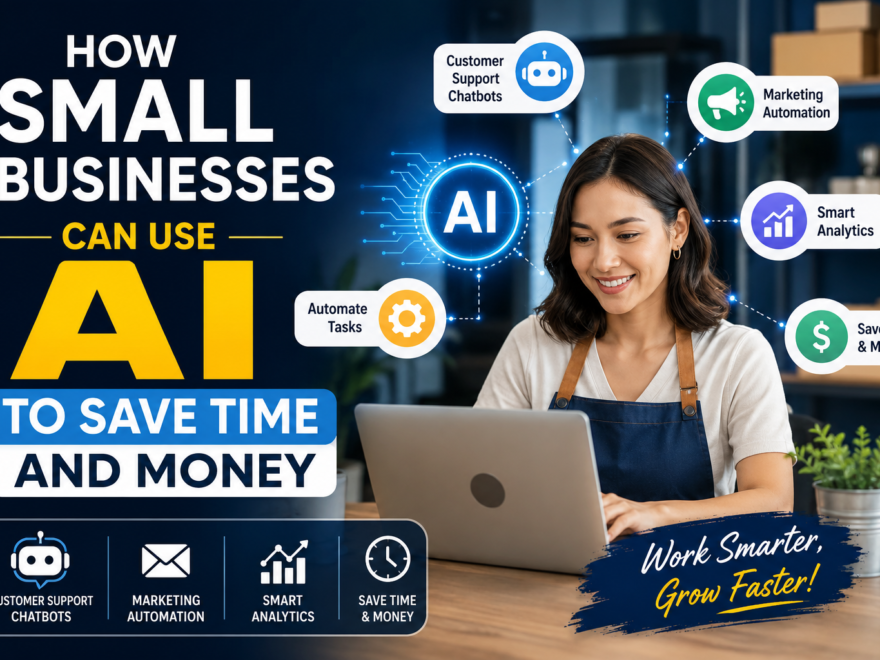
Artificial Intelligence (AI) is no longer just for large corporations with massive budgets. In 2026, affordable AI tools have made it possible for small businesses to automate repetitive tasks, improve customer experiences, and increase productivity without hiring additional staff.
Whether you run a local store, an online shop, a consulting business, or a startup, AI can help you work smarter while reducing costs. From customer support chatbots to marketing automation and business analytics, AI is becoming an essential tool for entrepreneurs.
🤖 Why Small Businesses Should Adopt AI
Small businesses often operate with limited staff and tight budgets. AI helps by handling routine tasks, allowing business owners and employees to focus on activities that generate revenue and strengthen customer relationships.
Key Benefits
- ⏰ Saves time through automation
- 💰 Reduces operating costs
- 😊 Improves customer satisfaction
- 📈 Increases sales opportunities
- 📊 Provides data-driven insights
- 🚀 Boosts productivity
Instead of replacing employees, AI enhances their efficiency by taking over repetitive and time-consuming work.
💬 1. Customer Support Chatbots
Customer service is one of the biggest areas where AI creates immediate value.
AI chatbots can answer customer questions 24/7 without requiring a human representative.
Common Tasks
- Order tracking
- Product recommendations
- Business hours
- Appointment booking
- FAQs
- Return policies
Example
Imagine an online clothing store.
Instead of answering:
- “Where is my order?”
- “What size should I buy?”
- “Do you ship internationally?”
hundreds of times every week, an AI chatbot answers instantly.
Benefits include:
- Faster response times
- Lower support costs
- Improved customer satisfaction
- Higher conversion rates
Even outside business hours, customers receive immediate assistance.
📧 2. Marketing Automation
Marketing often consumes hours every week.
AI automates repetitive marketing tasks while improving campaign performance.
AI Can Help With
- Writing email campaigns
- Creating social media posts
- Scheduling content
- Writing product descriptions
- Generating blog ideas
- Designing ad copy
Example
A bakery owner wants to promote weekend offers.
Instead of manually creating:
- Facebook posts
- Instagram captions
- Email newsletters
AI generates all of them in minutes.
This saves several hours every week.
📱 Social Media Management
AI tools can automatically:
- Suggest trending hashtags
- Generate captions
- Recommend posting times
- Repurpose blogs into social posts
- Analyze engagement
Small businesses can maintain a consistent online presence without hiring a full-time social media manager.
✍️ 3. AI Content Creation
Content marketing attracts customers through blogs, newsletters, videos, and educational articles.
AI helps generate:
- Blog posts
- Website content
- Product descriptions
- FAQs
- Video scripts
- Newsletters
Business owners spend less time writing while publishing more consistently.
📊 4. Business Analytics
Many businesses collect data but don’t know how to use it.
AI analyzes business information and turns it into actionable insights.
AI Can Analyze
- Sales trends
- Customer behavior
- Website traffic
- Marketing performance
- Inventory levels
- Seasonal demand
Example
A coffee shop notices declining weekday sales.
AI identifies:
- Most profitable products
- Peak customer hours
- Best-performing promotions
- Repeat customer patterns
The owner can then launch targeted promotions instead of relying on guesswork.
🛍️ 5. Inventory Management
Keeping too much inventory wastes money.
Keeping too little inventory loses sales.
AI predicts demand based on:
- Previous sales
- Holidays
- Weather
- Seasonal trends
- Customer behavior
This reduces:
- Overstocking
- Stock shortages
- Waste
- Storage costs
📅 6. Scheduling and Appointment Management
Service businesses can automate appointment booking.
Examples include:
- Salons
- Clinics
- Consultants
- Fitness trainers
- Repair services
AI assistants can:
- Book appointments
- Send reminders
- Reduce no-shows
- Reschedule automatically
This eliminates many repetitive administrative tasks.
💼 7. Sales Assistance
AI can support sales teams by identifying the most promising leads.
AI Helps By
- Scoring leads
- Recommending follow-ups
- Personalizing offers
- Predicting customer purchases
Example:
An online electronics store notices a customer browsing laptops repeatedly.
AI automatically suggests:
- Accessories
- Warranty plans
- Discounts
- Similar products
This increases average order value.
📧 8. Email Management
Business owners often spend hours sorting through emails.
AI can:
- Summarize long email threads
- Draft replies
- Categorize messages
- Prioritize urgent requests
- Extract action items
Instead of reading dozens of emails, owners can focus on the most important ones.
💰 9. Financial Management
AI simplifies bookkeeping by automating routine accounting tasks.
Examples include:
- Expense tracking
- Invoice generation
- Receipt scanning
- Cash flow forecasting
- Budget recommendations
This reduces manual errors and saves valuable administrative time.
📞 10. Voice AI for Customer Calls
AI voice assistants can answer phone calls when staff members are unavailable.
They can:
- Answer FAQs
- Schedule appointments
- Route calls
- Collect customer information
This ensures customers receive timely assistance even during busy periods.
📈 11. Predictive Analytics
AI doesn’t just report what happened—it can help forecast what is likely to happen next.
Businesses can predict:
- Future sales
- Customer demand
- Product popularity
- Marketing ROI
- Churn risk
These insights support better planning and smarter decisions.
🔍 12. AI for Hiring
Recruitment can be time-consuming for small businesses.
AI can:
- Screen resumes
- Match candidates to job requirements
- Schedule interviews
- Summarize applicant profiles
While final hiring decisions should always involve human judgment, AI significantly reduces administrative workload.
💡 Real-World Examples
Local Restaurant
Uses AI to:
- Take reservations
- Answer customer questions
- Create weekly promotions
- Forecast ingredient demand
Online Store
Uses AI to:
- Recommend products
- Write product descriptions
- Automate email campaigns
- Provide 24/7 customer support
Marketing Agency
Uses AI to:
- Draft client proposals
- Generate content ideas
- Analyze campaign performance
- Summarize meeting notes
Dental Clinic
Uses AI to:
- Schedule appointments
- Send reminders
- Answer common patient questions
- Reduce missed appointments
Tips for Getting Started
If you’re new to AI, start with one or two high-impact use cases:
- Identify repetitive tasks that consume the most time.
- Choose AI tools that integrate with your existing software.
- Test AI on a small workflow before expanding.
- Review AI-generated content and decisions for accuracy.
- Measure time and cost savings to evaluate the return on investment.
Common Mistakes to Avoid
- Expecting AI to replace all human work.
- Automating poor or inefficient processes.
- Ignoring data privacy and security.
- Using too many AI tools at once.
- Failing to monitor AI-generated outputs.
AI works best when it complements human expertise rather than replacing it.
The Future of AI for Small Businesses
AI capabilities are becoming more accessible every year. Future advancements are likely to include:
- More personalized customer interactions
- Smarter business forecasting
- Greater automation across business operations
- Improved voice and multilingual support
- AI assistants that coordinate tasks across multiple business applications
Businesses that adopt AI thoughtfully today will be better positioned to compete, scale efficiently, and deliver better customer experiences.
Conclusion
Artificial intelligence has become a practical, affordable tool for small businesses looking to save time and reduce costs. Whether it’s automating customer support with chatbots, streamlining marketing campaigns, analyzing sales data, or improving inventory management, AI enables business owners to focus on strategic growth instead of repetitive tasks.
The key is to begin with a clear business need, implement AI gradually, and combine automation with human oversight. By doing so, small businesses can increase productivity, improve customer satisfaction, and remain competitive in an increasingly digital marketplace.