🤖 Introduction
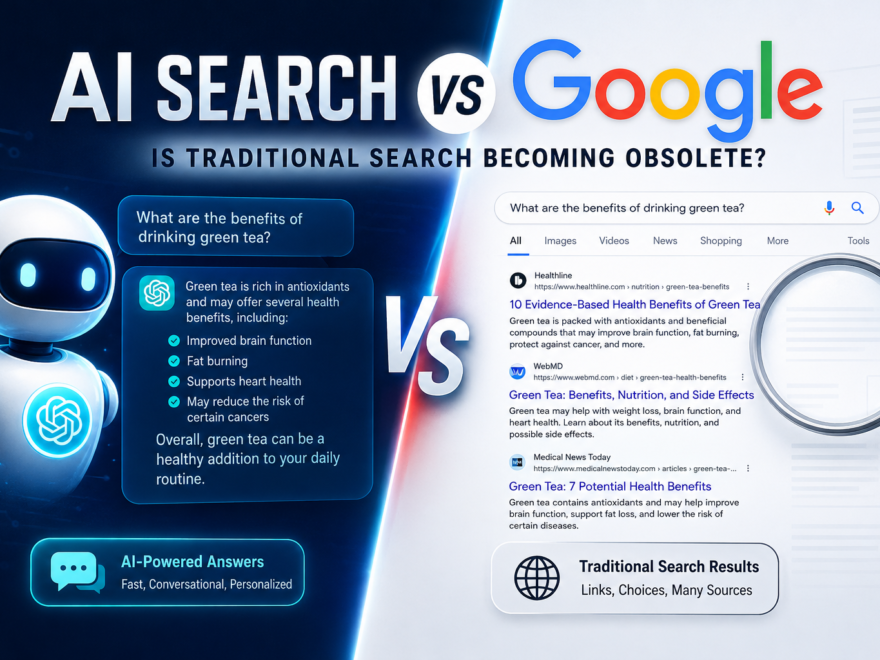
For more than two decades, Google has been the gateway to the internet. Whether people wanted to find recipes, research a topic, compare products, or get directions, traditional search engines were the first stop. But in 2026, a new competitor has emerged: AI-powered search.
Tools like ChatGPT, Perplexity AI, Claude, Gemini, and Microsoft’s AI-powered Copilot are changing how people find information. Instead of scrolling through pages of links, users receive direct, conversational answers tailored to their questions.
This shift has sparked an important question:
Is traditional search becoming obsolete?
The answer isn’t simply yes or no. AI search is transforming the search experience, but traditional search engines still offer strengths that AI cannot completely replace. This article explores how AI search works, compares it with Google Search, and examines what the future of online search may look like.
📈 The Evolution of Search
The internet has experienced several major shifts:
- 🌐 Directory-based websites (1990s)
- 🔎 Keyword search engines (2000s)
- 📱 Mobile-first search (2010s)
- 🎙️ Voice search and smart assistants
- 🤖 AI-powered conversational search (2023–2026)
Traditional search requires users to enter keywords and choose among multiple websites. AI search simplifies this process by understanding natural language and generating complete answers.
Instead of typing:
“best laptop under $1000 2026”
Many users now ask:
“I’m a college student studying engineering. Which laptop under $1000 should I buy?”
AI understands the context and provides personalized recommendations.
🔍 What Is AI Search?
AI search combines:
- Large Language Models (LLMs)
- Natural Language Processing (NLP)
- Machine Learning
- Knowledge Graphs
- Real-time web information (in many AI systems)
Rather than listing websites, AI summarizes information into a conversational response.
Popular AI search tools include:
- ChatGPT Search
- Perplexity AI
- Google AI Mode
- Google AI Overviews
- Microsoft Copilot
- Claude
- Gemini
These platforms aim to reduce the time users spend clicking between multiple websites.
🌐 How Traditional Google Search Works
Google primarily works by:
- Crawling billions of web pages.
- Indexing content.
- Ranking pages using hundreds of signals.
- Displaying relevant links.
Users must:
- Open multiple websites
- Compare information
- Read articles
- Decide which source is trustworthy
Although Google increasingly includes AI-generated summaries, its foundation remains web-page ranking.
⚡ How AI Search Works Differently
AI search changes the workflow.
Instead of:
Question → Links → Reading → Answer
It becomes:
Question → AI Understanding → Direct Response
For example:
Traditional Search:
“Symptoms of Vitamin D deficiency”
Results:
- Healthline
- Mayo Clinic
- NHS
- WebMD
AI Search:
“Common symptoms include fatigue, muscle weakness, bone pain, mood changes, and frequent illness. These symptoms can have many causes, so consult a healthcare professional for evaluation.”
The user receives an immediate summary.
📊 AI Search vs Google
| Feature | AI Search | Traditional Google |
|---|---|---|
| Conversational | ✅ | ❌ |
| Direct answers | ✅ | Limited |
| Multiple sources summarized | ✅ | User reads manually |
| Website links | Sometimes | Always |
| Personalization | High | Moderate |
| Context awareness | Excellent | Limited |
| Follow-up questions | Easy | Difficult |
| Shopping results | Improving | Excellent |
| Local businesses | Excellent | Excellent |
| Breaking news | Depends on system | Excellent |
| Research depth | Good | Excellent with multiple sources |
🚀 Advantages of AI Search
1. Saves Time
Users no longer need to open ten browser tabs.
The AI summarizes everything instantly.
2. Natural Conversations
Instead of guessing keywords, users simply ask questions naturally.
Example:
“Explain quantum computing like I’m 12.”
3. Better Learning Experience
Students often prefer AI because they can ask follow-up questions.
Example:
“What does photosynthesis mean?”
Follow-up:
“Explain it using football.”
4. Personalized Recommendations
AI considers context.
Instead of:
“Best running shoes”
Users ask:
“I run three times a week, have flat feet, and need shoes under $120.”
5. Better Productivity
Professionals use AI search to:
- Summarize reports
- Compare products
- Draft emails
- Explain technical topics
- Research faster
⚠️ Where Traditional Google Still Wins
1. Real-Time News
Google indexes breaking news almost instantly.
AI models may rely on delayed or limited live data depending on the platform.
2. Shopping
Google Shopping remains stronger for:
- Prices
- Availability
- Reviews
- Retailers
3. Local Businesses
Need:
- Restaurants
- Dentists
- Hotels
- Maps
Google Search combined with Maps remains highly effective.
4. Website Discovery
Sometimes users don’t want summaries.
They want:
- Official websites
- Forums
- Research papers
- PDFs
- Videos
Google excels here.
5. Source Verification
Researchers often prefer reading original sources instead of AI-generated summaries.
🎯 How User Behavior Is Changing
Instead of typing:
“How to lose weight”
People ask:
“I work night shifts and only have 20 minutes to exercise. What’s the best weight-loss plan?”
Search is becoming conversational.
Users expect personalized answers instead of generic lists.
📉 Challenges Facing Traditional Search
Traditional search faces several issues:
- Too many ads
- SEO spam
- Clickbait content
- Low-quality AI-generated articles
- Multiple tabs required
- Information overload
AI search attempts to solve these problems by synthesizing information into concise answers.
🤖 Challenges Facing AI Search
AI search is powerful but not perfect.
Potential drawbacks include:
Hallucinations
AI may occasionally generate incorrect or fabricated information.
Missing Sources
Some AI responses do not clearly cite where information came from.
Outdated Information
Not every AI system has access to the latest web content.
Reduced Website Traffic
If users receive answers directly, they may never visit publishers’ websites, affecting creators and businesses.
🌍 Impact on SEO
Search Engine Optimization is evolving.
Instead of optimizing only for keywords, websites now need to focus on:
- Expertise
- Authority
- Trustworthiness
- Original research
- Helpful content
- Structured data
- Clear answers to user questions
This shift is often called Answer Engine Optimization (AEO) or Generative Engine Optimization (GEO).
📱 AI Search Is Becoming Multimodal
Modern AI search can understand:
- Text
- Images
- Voice
- PDFs
- Videos
- Screenshots
Example:
Upload a photo of a plant and ask:
“What’s wrong with this leaf?”
Or upload a chart and ask:
“Explain these results.”
🔮 The Future of Search
Over the next few years, search is likely to become:
- More conversational
- Highly personalized
- Voice-first
- Visual and multimodal
- Integrated into everyday apps
- Agentic, with AI helping complete tasks, not just finding information
Instead of merely answering questions, AI assistants may:
- Book appointments
- Compare products
- Plan trips
- Organize schedules
- Complete online tasks on your behalf (with your permission)
🏆 Will Google Disappear?
Probably not.
Google has already integrated AI features into its search experience and continues to evolve. Rather than disappearing, traditional search is adapting to a world where AI plays a much larger role.
The future is likely to be hybrid:
- Use AI for explanations, brainstorming, summaries, and conversational research.
- Use traditional search for discovering websites, comparing products, finding local businesses, and accessing the latest news.
💡 Final Thoughts
AI search is reshaping how we access information, making search faster, more interactive, and easier to use. However, traditional search engines remain essential for navigating the web, verifying sources, and finding real-time information.
Instead of replacing Google entirely, AI is redefining what users expect from search. The most effective approach is to combine both: let AI accelerate understanding while traditional search provides access to the original sources and the broader web.
📌 FAQs
Q1. Is AI search better than Google?
It depends on the task. AI is excellent for explanations, summaries, and conversations, while Google is stronger for real-time news, website discovery, and comprehensive web navigation.
Q2. Will AI replace search engines?
AI is more likely to complement and transform search engines than replace them entirely.
Q3. Why are people using AI search more often?
It offers faster, conversational answers, supports follow-up questions, and can personalize responses based on context.
Q4. Does AI search always provide accurate information?
No. AI can make mistakes or present outdated information, so it’s important to verify critical information using reliable sources.
Q5. What does this mean for website owners?
Creating original, trustworthy, and user-focused content remains crucial. Optimizing for both traditional search and AI-powered answer engines will become increasingly important.