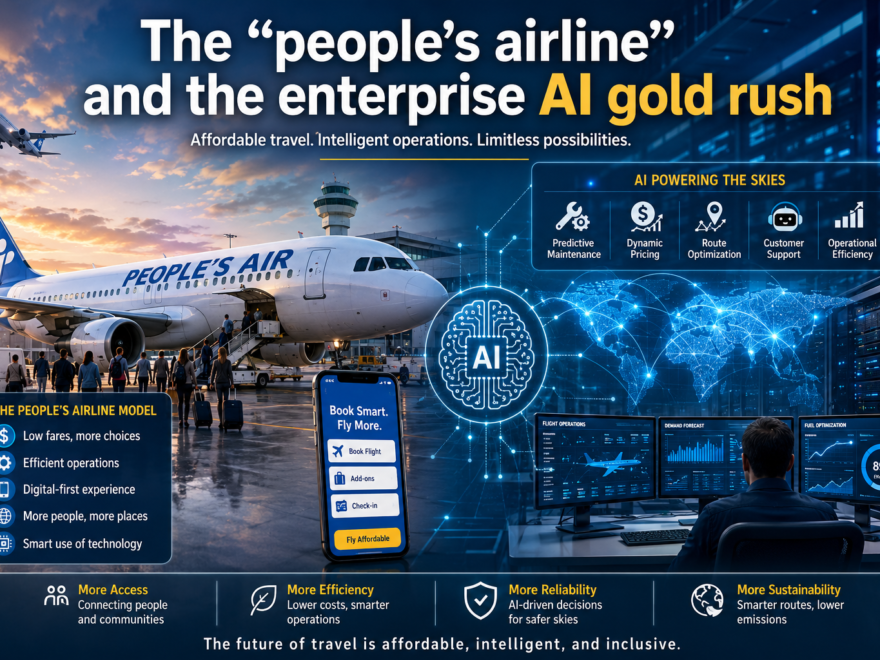
The global airline industry has long been associated with high operational costs, thin profit margins, and fierce competition. Yet in recent years, a new generation of low-cost carriers has transformed the market by making air travel affordable for millions of people. Often referred to as “people’s airlines,” these companies focus on accessibility, efficiency, and digital innovation to attract budget-conscious travelers. At the same time, a different revolution has been unfolding in the technology sector: the enterprise AI gold rush.
Artificial intelligence has become one of the most valuable investments for corporations worldwide. Businesses are racing to adopt AI-powered tools that improve productivity, automate workflows, and generate insights faster than ever before. The intersection between affordable aviation and enterprise AI represents a fascinating shift in how technology is reshaping industries once considered traditional and slow-moving.
How “People’s Airlines” Changed Modern Travel
Low-cost airlines emerged with a simple but powerful mission: make flying affordable for ordinary people. By reducing unnecessary luxuries and focusing on operational efficiency, these airlines opened air travel to a much broader audience.
Budget carriers achieved this by:
- Using single aircraft models to simplify maintenance
- Offering direct online booking systems
- Charging separately for optional services
- Optimizing fuel efficiency and flight schedules
- Expanding routes to underserved regions
As a result, millions of travelers who once relied on trains or buses gained access to faster transportation options. Affordable airfare also boosted tourism, business opportunities, and regional economic growth.
Digital transformation played a major role in this success. Airlines adopted mobile apps, automated check-ins, dynamic pricing systems, and AI-assisted customer support to improve efficiency while keeping costs low.
The Rise of the Enterprise AI Gold Rush
While airlines modernized their operations, the corporate world entered an intense race to adopt artificial intelligence technologies. Companies across finance, healthcare, retail, logistics, and manufacturing began investing heavily in AI solutions to gain a competitive edge.
The enterprise AI boom is driven by several factors:
- Increased availability of cloud computing
- Advances in machine learning models
- Demand for automation and productivity
- Growth of big data analytics
- Pressure to reduce operational costs
Businesses now use AI for:
- Customer service chatbots
- Fraud detection systems
- Predictive analytics
- Personalized marketing
- Supply chain optimization
- Software development assistance
Major technology firms are competing to dominate this rapidly expanding market, with billions of dollars flowing into AI infrastructure, research, and enterprise software platforms.
How AI Is Transforming Airlines
The aviation industry itself has become a major beneficiary of AI innovation. Airlines increasingly rely on artificial intelligence to optimize operations and enhance customer experiences.
Some of the most important applications include:
- Predictive maintenance to reduce aircraft downtime
- AI-powered pricing models for ticket sales
- Route optimization for fuel savings
- Personalized travel recommendations
- Automated baggage tracking systems
- Virtual customer support assistants
For low-cost airlines, AI provides a powerful advantage because it helps reduce expenses while improving efficiency. This aligns perfectly with the mission of “people’s airlines” to deliver affordable travel without sacrificing convenience.
AI can also help airlines manage disruptions more effectively. During weather delays or operational issues, machine learning systems can quickly suggest alternative schedules and allocate resources efficiently.
Risks and Challenges in the AI Race
Despite the excitement surrounding enterprise AI, the gold rush also brings significant risks. Many companies are investing heavily in AI without fully understanding its long-term implications.
Key concerns include:
- Data privacy and cybersecurity risks
- Bias in AI decision-making systems
- High infrastructure costs
- Dependence on large technology providers
- Workforce disruption through automation
- Regulatory uncertainty
In aviation, AI systems must meet extremely high safety standards. Even small errors can have major consequences. This means airlines must balance innovation with strict compliance and human oversight.
The rapid expansion of AI also raises concerns about job displacement. Automation could reduce the need for certain administrative and customer service roles, even as it creates demand for highly skilled AI specialists.
The Future of Affordable Travel and AI
The combination of low-cost aviation and enterprise AI could redefine global transportation in the coming decades. Future airlines may operate with highly automated systems that improve safety, efficiency, and sustainability simultaneously.
Possible future developments include:
- AI-driven autonomous airport operations
- Smarter fuel management systems
- Personalized travel experiences powered by generative AI
- Advanced predictive maintenance networks
- More sustainable flight planning to reduce emissions
As AI technology continues to evolve, companies that successfully combine affordability with intelligent automation may dominate the next era of travel and enterprise innovation.
The “people’s airline” movement demonstrated that technology can make essential services more accessible to ordinary consumers. The enterprise AI gold rush is now expanding that idea across nearly every industry, reshaping how businesses operate and how people experience the modern world.